Showing posts with label Germany. Show all posts

Friday, 20 November 2015

A swap three-ways

Stuttgart and the Fernsehturm Stuttgart
25 May 2015 | From Theresa of Germany
SURPRISE POSTCARD

I received this postcard in an interesting way. Theresa's penfriend from Vietnam, Phúc, asked me for a swap - a Tarsier postcard in particular. I sent her the postcard with some other stuffs in an envelope. The postcard is written - though the address part is blank. I received some stuffs from Phúc as well, and another surprise postcard. Phúc then sent the tarsier postcard to Theresa, and Theresa, after some time, sent me this postcard.

Stuttgart is the capital and largest city of the state of Baden-Württemberg in southwest Germany. It is spread across a variety of hills (many of them vineyards), valleys and parks – unusual for a German city and often a source of surprise to visitors who primarily associate the city with its industrial reputation as the 'cradle of the automobile'. Stuttgart has the status of Stadtkreis, a type of self-administrating urban county.

Stuttgart is nicknamed the Schwabenmetropole (Swabian metropolis), because of the city's location in the centre of Swabia, and as a reference to the Swabian dialect spoken by its native inhabitants.

In the postcard is the Fernsehturm Stuttgart (Stuttgart TV Tower), a 216.61 m (710.7 ft) telecommunications tower in Stuttgart, Germany. It was the first tower in the world constructed from concrete, and it is the prototype for many such towers world-wide. The tower is located on Hoher Bopser Hill in the southern Stuttgart district of Degerloch.

Wednesday, 18 November 2015

Go Left

When it doesn't feel right, go left
6 May 2015 | From Christoph of Germany
OFFICIAL POSTCROSSING

When did 'right' become synonymous with 'correct'? The left path is just as valid as the right one. So when it doesn't feel right, go left. As Einstein puts it, "The one who follows the crowd will usually go no further than the crowd. The one who walks alone is likely to find himself in places no one has ever been before."

Wednesday, 2 September 2015

Sights and scenes: Lüneburger Heide

Lüneburger Heide
21 Apr 2015 | From Andreas of Germany
POSTCROSSING FRIEND

This postcard arrived along with the book that Andreas sent me for my birthday. He shared that the postcard will give me an impression of the place where he live. 

Lüneburg Heath (German: Lüneburger Heide) is a large area of heath, geest and woodland in the northeastern part of the state of Lower Saxony in northern Germany. It forms part of the hinterland for the cities of Hamburg, Hanover, and Bremen and is named after the town of Lüneburg. Most of the area is a nature reserve. Northern Low Saxon is still widely spoken in the region.

Lüneburg Heath has extensive areas of heathland, typical of those that covered most of the North German countryside until about 1800, but which have almost completely disappeared in other areas. From a geographical point of view, Lüneburg Heath is a specific natural region, that is an area distinguished by a specific combination of abiotic factors (climate, relief, water resources, soil, geology) and biotic factors (flora and fauna).

How do you say 'book' in German?

Pilgern de Luxe by Andreas Zimmermman
21 Apr 2015 | From Andreas of Germany
POSTCROSSING FRIEND

Here are the contents of the parcel which I received from Andreas last April 10th. I waited eleven days before I could finally open it (I never peeked!). But even before opening the parcel I can already tell that it was a book. I have been 'touching' and 'feeling' the package for days! What kept the suspense is the anticipation of finally knowing what book it was.

To my surprise, it was a book completely written in German - and was written by Andreas himself! I never knew he was an author! I think the title is translated as 'De Luxe Pilgremage' in english. I haven't read musch of the book now - I first need to learn the German language - only a few pages to which my friend would laugh at me for my funny and weird accent and pronunciations. She's Filipino-German. She knows better German than me.

According to Andreas the book is about their, his and his wife's, 3,000 km walk from Wolgsthal in East of Austria to Santiago in West of Spain. On the cover is the boots he was wearing up to the 2,000 km.

The German word for "book" is "buch".

Wednesday, 12 August 2015

Cat-typing

A cat and his card
17 Apr 2015 | From Karin of Germany
OFFICIAL POSTCROSSING

Karin translates 'Muss ja auch kein Brief sein... Karte reicht' as 'It must not be a letter - a card is enough'. Might be one smart cat to be able to hand-type a card, even more to actually think of writing one. Cats can be pretty lazy most of the times. Then again they also have this personality of playing and messing things around. Yeah, maybe he just got curious with the typewriter and started hitting up the keys :p

The cat postcard comes with a matching cat-stamp along with a pair of squirrels :)

Monday, 22 June 2015

Skye Highland Cattle

Hairy Highland Cattle at Skye
30 Mar 2015 | From Rosi of Germany
OFFICIAL POSTCROSSING

Skye, or the Isle of Skye, is the largest and most northerly large island in the Inner Hebrides of Scotland. The main industries are tourism, agriculture, fishing and forestry. Skye is part of the Highland Council local government area. The island's largest settlement is Portree, known for its picturesque harbour.

The Highland cattle are a Scottish breed of cattle. They have long horns and long wavy coats that are coloured black, brindled, red, yellow, or dun, and often primarily farmed for their meat. They originated from the Highlands and Western Isles of Scotland and were first mentioned in 6th century A.D. They are a hardy breed due to their native environment, the Scottish Highlands. Bulls can weigh up to 800 kilogrammes and cows up to 500 kilogrammes. Their milk generally has a very high butterfat content and their meat is regarded as one of the highest quality.

Cat walk

Two Cats Walking
30 Mar 2015 | From Silvia of Germany
OFFICIAL POSTCROSSING

This postcard reminds me of the time when I was young and used to bring home all the stray cats I would see in the streets. I would sneak them inside our home, hoping that my mom wouldn't see me. And every time she does, I would receive some scoldings from her. But eventually, my parents will let me keep them. I guess I do have a soft spot for cats and kittens. Our house was like a little cat sanctuary back then.

But of course, all good things must come to an end. When we start renovating our home - and literally tore the house down - most of the cats left our home in fear. And they never came back. Well some did. And were eventually sent to new homes when I have to move to the city to start college.

Now we have two cats at home. A Birman named Nog, and a Persian cat named Snow. They don't always walk side-by-side. But they are friendly enough with each other.

Friday, 19 June 2015

Arch bridges

The Arch bridge design
30 Mar 2015 | From Jenson of Germany
OFFICIAL POSTCROSSING

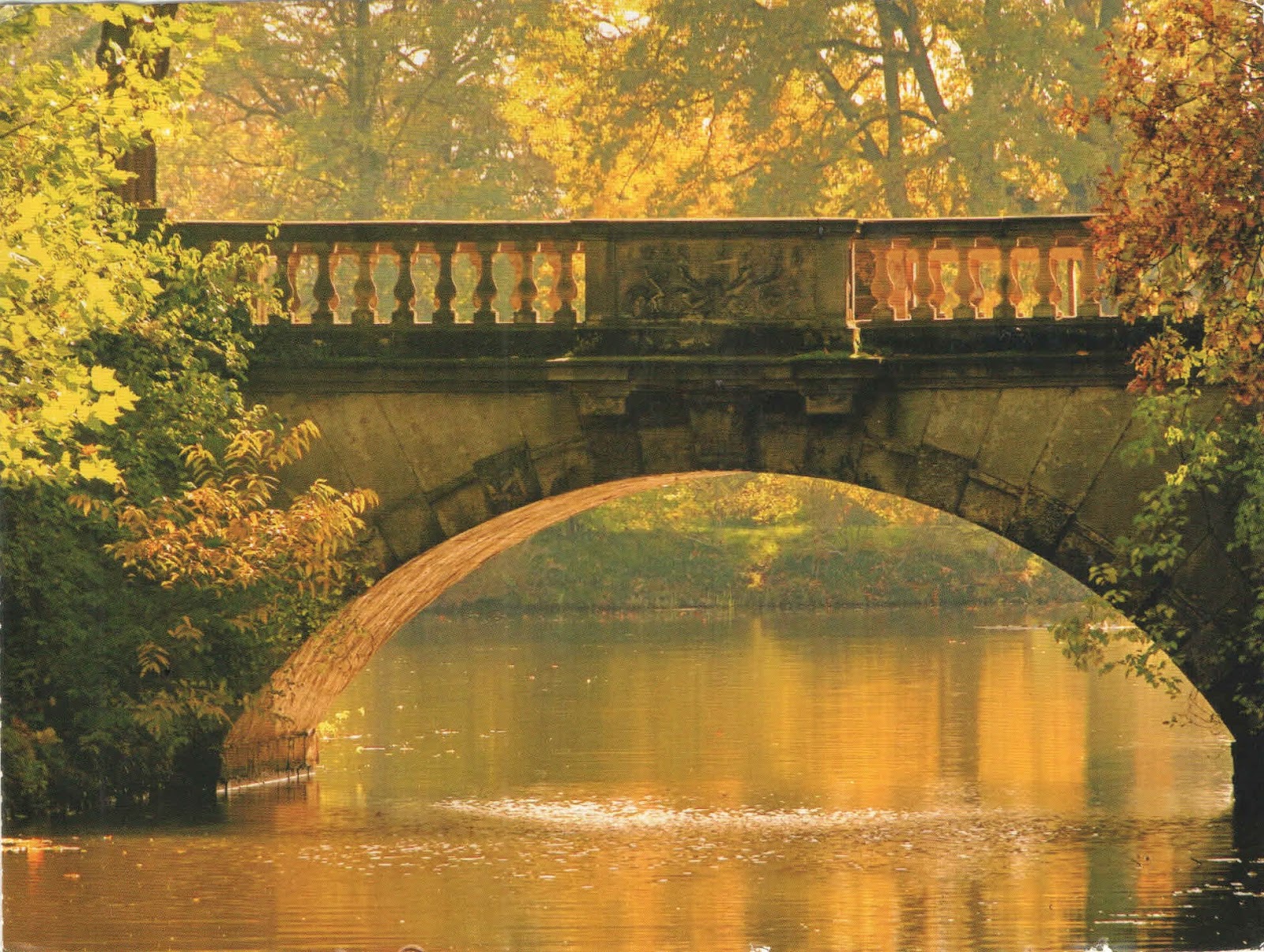
An arch bridge is a bridge with abutments at each end shaped as a curved arch. Arch bridges work by transferring the weight of the bridge and its loads partially into a horizontal thrust restrained by the abutments at either side. Possibly the oldest existing arch bridge is the Mycenaean Arkadiko bridge in Greece from about 1300 BC. Although true arches were already known by the Etruscans and ancient Greeks, the Romans were - as with the vault and the dome - the first to fully realize the potential of arches for bridge construction. Roman engineers were the first and until the industrial revolution the only ones to construct bridges with concrete, which they called Opus caementicium. The outside was usually covered with brick or ashlar, as in the Alcántara bridge.

The Philippines have some arch bridges as well. One is the Jones Bridge. It is a bridge that spans the Pasig River in the Philippines. Its Neoclassical design by Juan M. Arellano was an ornate concrete arch bridge. The bridge was destroyed by the bombs of World War II.

Another is the San Juanico Bridge with an Arch-shaped truss bridge design. It is the longest bridge in the Philippines spanning a body of seawater. The bridge was slightly damaged by Typhoon Haiyan in November 2013 but repaired.

Vintage Home Interior

A place of calm tranquility
30 Mar 2015 | From Inga of Germany
OFFICIAL POSTCROSSING

Inga shared that this is her most favourite postcard. She describes the picture, which is a Tomasz Zajda photograph, as showing deep silence and well-secured place. There are no other thing needed - just some candles, a cup of coffee, and your thoughts.

The room does give a warm and homely feeling. A place where you can sit and relax after a long, tiring day. A place where you can be alone with your thoughts and be perfectly away. A place where you can enjoy good food and conversations. A place that is home.

Thursday, 28 May 2015

Greetings from Aachen

Abendlicher Dom. Aachen Cathedral at night
10 Mar 2015 | From Michael of Germany
OFFICIAL POSTCROSSING

This is the second postcard Michael sent me which shows the Aachen Cathedral. Frequently referred to as the "Imperial Cathedral", it is a Roman Catholic church in Aachen, Germany. The church is the oldest cathedral in northern Europe and was known as the "Royal Church of St. Mary at Aachen" during the Middle Ages. For 595 years, from 936 to 1531, the Aachen chapel was the church of coronation for 30 German kings and 12 queens. The church is currently the episcopal seat of the Diocese of Aachen, so named in 1802.

Aachen Cathedral is the cathedral church of the Diocese of Aachen. The present-day cathedral consists of several constructions whose respective times of formation include the periods of early middle ages to modern times. The Cathedral is the church of the coronation for 30 German Kings.

Since 1978, the Cathedral of Aachen was listed as a UNESCO World Cultural Heritage Site.

A Klaus D. Schiemann artwork

Learning to read in the heart
10 Mar 2015 | From Michael of Germany
OFFICIAL POSTCROSSING

Michael sent me two postcards, and this is one of them. It is a postcard from a artist in his city that he is very fond of. He would spend hundreds for the artist's postcards, and would visit his studio often. The artist's name is Klaus D. Schiemann. 

Born in 1955, he is a German artist from Mülheim an der Ruhr and had drawn, among other things, a series of illustrations for the Heyne Publishing House - Conan series. For the Mythor series, as the successor to Helmut W. Pesch, he created on tickets for novels a series of schematic detailed maps and infographics. After many other works, poster designs and several book publications he now operates as a graphic artist and painter his own gallery "Wall 17" in Mülheim an der Ruhr.

Wednesday, 27 May 2015

Postcardbook: Romantische Momente | Romantic Moments

Heart leaf
10 Mar 2015 | From Heike of Germany
OFFICIAL POSTCROSSING

When I was younger, I remember going to our backyard and garden looking for some odd-shaped leaves or just any leaf I fancy. I would press them between the pages of a book and let them dry up. I oftentimes use them as bookmarks or to decorate my books - or I would forget about them and then see them again when I flip open the same book after months, or even years. Almost all of my books back then has a leaf within its pages. Somehow I was convinced back then that a precious memory is stored in those old, dried leaves. A happy memory, a sad memory. But nonetheless all memories are special.

A living picture of history

Günter Zint, Panfoto & Sankt Pauli Museum
10 Mar 2015 | From Julia of Germany
OFFICIAL POSTCROSSING

A visit to the Hanseatic City of Hamburg should also lead travellers to the St. Pauli Museum. It is located in the eponymous district at Davidstrasse 17 and is easily accessible by public transport. Up to three million exhibits reveal a living picture of the district's history up to the present day. The St. Pauli Museum is surely one of the ones most worth seeing if you wish to gain insights into the life and development of this district.

The St. Pauli Museum considers itself a contemporary centre for recording history, yet its objectives are also in the area of district work and education. The permanent exhibition "Stories Become History" vividly demonstrates that the life of the district is the result of its residents and their backgrounds.

The museum provides a total of 160 sqm of exhibition space, and is based on an extensive collection by Günter Zint, a press photographer. Visitors can admire the world's largest collection of photos, documents and other exhibits relating to St. Pauli. The historic development of this well-known Hamburg district is thus vividly explained from the Middle Ages to the present.

Thursday, 14 May 2015

The Squat Revolution

The Hafenstraße
25 Feb 2015 | From Andreas of Germany
POSTCROSSING FRIEND

The postcard is such a fitting aide-memoire for what our country is celebrating today: the 29th anniversary of the People Power Revolution, or simply the EDSA Revolution. This event holds a special place in the hearts of many Filipinos as they remember a revolution that restored democracy in tour country in 1986. Though the situation and magnitude of these events are quite different, they both depict a fight for something that is important.

Hafenstraße is a common German abbreviation of St. Pauli-Hafenstraße, a street in St. Pauli, a quarter of Hamburg, Germany. It is known for a former squat. Although referred to as a squat, during its history various contracts existed between the occupants and the buildings' former owner, the City of Hamburg. To the squatter movement of the 1980s, Hafenstraße was a focal point for various social conflicts. Solidarity with these issues led to growing conflict with the state. Meetings were held at the end of the years 1984 to 1990, where up to 5000 people participated. Discussions covered topics such as squatting, anti-NATO politics, anti-nuclear politics, the question of political prisoners and international solidarity.

The firewall of the occupied house Bernhard-Nocht-Straße 16 All-Over mural by Harald Rosenberg. It consists of several smaller motifs that flow into one another. The sayings and writings on the facades of houses in the Harbor Street reflects the spirit of the republic in the 80s.

Hafenstraße in the St. Pauli district of Hamburg was a political place and a notorious squatters' hotspot. And from the crumbling and rotting houses, organized chaos, and riots and violent conflicts, this once rebellious street is now a picture of peaceful communal life. Hafenstraße's squatting days have already passed. Today, Hafenstraße consists of 12 houses owned by a cooperative administered by the residents. It has developed its own little infrastructure, bookshops, cafes, and bars. The houses are largely repaired and further renovations and constructions are planned and carried out. It has now become a much sought-after location. The battle is over.

Wednesday, 13 May 2015

Sightseeing in Hamburg

Hamburg, Germany
11 Feb 2015 | From Kay of Germany
OFFICIAL POSTCROSSING

Hamburg  is the second largest city in Germany and the ninth largest city in the European Union. The official name reflects its history as a member of the medieval Hanseatic League, as a free imperial city of the Holy Roman Empire, a city-state, and one of the 16 states of Germany.

Hamburg is a major transport hub and is one of the most affluent cities in Europe. The port of Hamburg, on the river Elbe, is the second largest port in Europe (after the Port of Rotterdam) and tenth largest worldwide. The city is a notable tourist destination for both domestic and overseas visitors. It has a well-deserved reputation as Germany's Gateway to the World. Hamburg is proud of its status as a "Free and Hanseatic City" and thus shares the same status as a province, making up one of Germany's 16 federal-states or Bundesländer.

Points of interest and landmarks in Hamburg includes Miniatur Wunderland, Aussenalster, The Town Hall, Church of St. Michael, Warehouse District, Alter Elbtunnel, Treppenviertel, Jungfernstieg, Harbor Piers, Rathausmarkt, Binnenalster, Ohlsdorf Cemetery, HafenCity, Imtech-Arena, St Nikolai Memorial, Millerntorstadion, St. Petri Kirche, Portugiesenviertel, The Schanzenviertel, Deichstrasse, Chile House, Leuchtturm Neuwerk, and Moenckebergstrasse Shopping among others.

Monday, 4 May 2015

An R. Wachtmeister cat illustration

Rosina's cat fascination
20 Jan 2015 | From Celine Adrienne of Germany 
POSTCROSSING SWAP

This is the third postcard inside Celine's envelope - an whimsical cat illustration from Rosina Wachtmeister. Rosina Wachtmeister (born in Vienna, 1939) is an Austrian artist, maker of, for instance, cat sculptures and portraits. She is a self-confessed cat lover, and her works of impressive and intensive colours, come into being in her artistic domain in a small town in Umbria, not far from the Italian capital city. She creates an electrifying intoxication of colours that spreads pure energy.

In addition to the enchanting colourful cats, coffee cups and many other gift and decorative accessories bear the unmistakable signature of the artist Rosina Wachtmeister. Check out her official site here.

Sunday, 3 May 2015

Three cats in a card

My pet cat
20 Jan 2015 | From Celine Adrienne of Germany 
POSTCROSSING SWAP

This is one of the three postcards inside an envelope that Celine sent me. Two are cat postcards - she thought of sending me those as she believed I collect cat postcards. Unconsciously I may have been collecting cat-themed postcards. I am fond of cats and have received some cat postcards over my Postcrossing years.

At the back of the postcard is a cat sticker (top) and a cat painting (below) I supposed she drew by herself. She asked if I have any pet cats. I used to, but now we have a family cat and she lives with my family in our hometown. She's a Birman, also called the "Sacred Cat of Burma". Her name's Nami. But my niece kept calling her Nognog.

Merry Christmas from Germany

Christmas in Germany
20 Jan 2015 | From Celine Adrienne of Germany 
POSTCROSSING SWAP

'Frohe Weihnachten!'

Christmas, or Weihnachten, is considered by Germans to be the most important of the major holidays. The German holiday season is a time for introspection, celebration, and family and friends; it is less consumption-oriented than in the United States. Christmas preparations often begin on the eve of December 6th. People often set aside special evenings for baking spiced cakes and cookies, and making gifts and decorations.

Both December 25 and 26 are legal holidays in Germany and are known as the First and Second Christmas Day respectively. Businesses are closed, and time is spent visiting with extended family. Goose is the traditional fare on the First Christmas Day, or perhaps rabbit or a roast. These are accompanied by traditional German fare such as apple and sausage stuffing, red cabbage, and potato dumplings. The second Christmas day is usually a quieter time, a day for peaceful contemplation.

In parts of Germany, people believe that the Christ Child sends a messenger in Christmas Eve. He appears as an angel in a white robe and crown, bearing gifts. The angel is called Christkind. There is also a Christmas Eve figure called Weihnachtsmann or Christmas Man, he looks like Santa Claus and also brings gifts.

Christmas Trees are very important in Germany. They were first used in Germany during the Middle Ages. The Christmas tree was traditionally brought into the house on Christmas eve. Germany is also well known for its Christmas Markets where all sorts of Christmas foods and decorations are sold. Perhaps the most famous German decorations are glass ornaments.

Friday, 17 April 2015

Frieden für alle, "Peace for all"
7 Jan 2015 | From Andreas of Germany
POSTCROSSING FRIEND

Peter Gut, "Frieden für alle"
Aus Dem Buch, "Tierisch Unter Strom"
Kein & Aber Verlag

At first, I wasn't able to get the humour shown in the postcard. Until I've read Andreas message telling me that the goose is a favourite German food during the Christmas season. So that's why he's gonna blast the stove!

Goose has a distinct flavor which makes it a favorite European Christmas dish. In Germany, roasted goose is a staple for Christmas Day meals. Roast goose is also a popular ingredient for post-Christmas meals. There are a number of recipes for Boxing Day which make use of left over roasted goose from one’s Christmas Day banquet. The most prevalent stuffings are apples, sweet chestnuts, prunes and onions. Typical seasonings include salt and pepper, mugwort, or marjoram. Also used are red cabbage, Klöße, and gravy, which are used to garnish the goose. Another version of roast goose is the Alsatian-style with Bratwurst-stuffing and sauerkraut as garnish.

Thursday, 26 March 2015

Gutacher costume from the Black Forest

The Bollenhut
7 Jan 2015 | From Quirin of Germany
OFFICIAL POSTCROSSING

Here's another postcard from Germany showing a traditional Black Forest costume - the Bollenhut. The Bollenhut has become a symbol of the Black Forest as a whole because of its picturesque appearance and the homeland films. Traditional costumes are still worn today on certain public holidays and in processions and folkloric events in many places in the Black Forest.

Gutach, a town in the district of Ortenau in Baden-Württemberg in Germany, is also where one of the last remaining bollenhut makers works her magic. It takes about one week and two kilograms of wool to make one of the hats. Red pompoms symbolize that the woman wearing the bollenhut is unmarried, whereas married women wear hats with black pompoms.