Showing posts with label Belarus. Show all posts

Wednesday, 18 November 2015

Fauna of Belarus: Red Deer

The Red Deer
6 May 2015 | From Pavel of Belarus
OFFICIAL POSTCROSSING

The red deer is one of the largest deer species. The red deer inhabits most of Europe, the Caucasus Mountains region, Asia Minor, Iran, parts of western Asia, and central Asia. It also inhabits the Atlas Mountains region between Morocco and Tunisia in northwestern Africa, being the only species of deer to inhabit Africa.

The red deer is the fourth-largest deer species behind moose, elk and sambar deer. It is a ruminant, eating its food in two stages and having an even number of toes on each hoof, like camels, goats and cattle. European red deer have a relatively long tail compared to their Asian and North American relatives. 

The closely related and slightly larger American elk or wapiti, native to North America and eastern parts of Asia, has been regarded as a subspecies of red deer, but recently been established as a distinct species. Probably the ancestor of all red deer, including wapiti, originated in central Asia and resembled sika deer.

The Most Famous Reggae Performer

Bob Marley
6 May 2015 | From Victor of Belarus
OFFICIAL POSTCROSSING

A Jamaican musician, guitarist, singer, and songwriter. The most famous reggae performer. 

Bob Marley served as a world ambassador for reggae music and sold more than 20 million records throughout his career—making him the first international superstar to emerge from the so-called Third World.

Bob Marley was born on February 6, 1945, in St. Ann Parish, Jamaica. In 1963, Marley and his friends formed the Wailing Wailers. The Wailers' big break came in 1972, when they landed a contract with Island Records. Marley went on to sell more than 20 million records throughout his career. Bob Marley helped introduce reggae music to the world and remains one of the genre's most beloved artists to this day. The son of a black teenage mother and much older, later absent white father, he spent his early years in St. Ann Parish, in the rural village known as Nine Miles.

Marley and Livingston devoted much of their time to music. Under the guidance of Joe Higgs, Marley worked on improving his singing abilities. He met another student of Higgs, Peter McIntosh (later Peter Tosh) who would play an important role in Marley's career.

Diagnosed with a type of malignant melanoma in 1977, Marley died on 11 May 1981 in Miami at the age of 36. He was a committed Rastafari who infused his music with a sense of spirituality. He is considered one of the most influential musicians of all time and credited with popularizing reggae music around the world, as well as serving as a symbol of Jamaican culture and identity. Marley has also evolved into a global symbol, which has been endlessly merchandised through a variety of mediums.

Sources: Wikipedia, Biography

Monday, 1 June 2015

Belarusian National Instrument

Bagpipe or "Duda"
18 Mar 2015 | From Helen of Belarus
OFFICIAL POSTCROSSING

The Belarusian Duda is a musical instrument of complex design with the following necessary parts: leather bag, and no less that three pipes of different size: "soska"('nipple"), "perabor"("finger runs") and "huk"("sound"). It is extremely well known and wide spread in the territories we now call Belarusian at least in the 19th and the beginning of the 20th, then almost forgotten after WWII. It has been brought to live again starting from 1980s.

The bag is usually created from the skin of badger, goat or calf. The skin was stitched with the fur in and had only single minimal seam (double stitch). An additional leather band is stitched on top of double stitch to air-seal the bag. Two holes were left open - neck and behind - then bag was turned inside out with fur out. The soska is a small maple pipe gradually narowing to the top. It was used to blow air inside the bag. The perabor is used to play the melody. The huk is made from a large maple stick with 'pishchyk' (goose feather or a straw) and 'rahaven' (horn).

Two general types of bagpipes were known on described territories: in the Middle Ages these were so called “medieval bagpipes”, spread all over the Europe of the time and disappeared together with a chivalry culture. But later on, in ethnographic period we found another type of bagpipes, even several of them. These are a single-drone bagpipe with a wood carved horns on a chanter and a drone (the most famous nowadays), a two-drones bagpipe (not too much is known about it) and dudá-maciánka with at least three drones and no horns. 

Wednesday, 27 May 2015

The Belarusian alphabet

Speak and write in Belarusian
10 Mar 2015 | From Natasha of Belarus
OFFICIAL POSTCROSSING

The Belarusian alphabet is based on the Cyrillic script and is derived from the alphabet of the Old Church Slavonic language. The alphabet has existed in its modern form since 1918 and consists of thirty-two letters. Belarusian is an Eastern Slavonic language with about 7.5 million speakers in Belarus. It is closely related to Russian and Ukrainian. Most Belarusians are bilingual in Belarusian and Russian.

Some Belarusian Phrases (as shown in the postcard):
What's your name? - Як цябе завуць? (Jak tsiabe zavuts'?)
Hello - Прывітанне (Pryvitan'ne)
My name is... - Мяне завуць... (Miane zavuts')
Goodbye  - Пакуʌь? (Pakul') | Да пабачэньня (Da pabachen'nia)
Nice to meet you - Прыемна пазнаёміцца! (Pryjemna paznajomitsa!)
Thank you - Дзякуй (Dziakuj)
You are welcome - Kaʌi ʌacкa! (Kali laska!)
I love you - Я цябе кахаю (Ja tsiabe kahaju)
Happy birthday - З Днём Нараджэння! (Z Dniom Naradzhen'nia!)

Monday, 11 May 2015

A Sergey Kozlov fairytale

Hedgehog in the fog
3 Feb 2015 | From Diana of Belarus
OFFICIAL POSTCROSSING

The postcard shows an illustration from the children's book 'Hedgehog in the fog' written by Sergei Kozlov. The book is about two friends, a little hedgehog and a bear cub. The little hedgehog (voiced by Mariya Vinogradova), who is on his way to visit his friend the bear cub. The two would meet every evening to drink tea from the cub's samovar, which was heated on a fire of juniper twigs. As they drank their tea, the hedgehog and the bear would chat and count the stars together.

On this day, the hedgehog decides to bring the bear cub some raspberry jam. As Hedgehog heads out, a sinister looking eagle-owl is following him. Hedgehog passes through the woods and encounters a beautiful white horse standing in a fog. He is curious as to whether the horse would drown if it went to sleep in the fog. The hedgehog decides to explore the fog for himself. As he goes down an incline into the fog, it is soon so thick that the hedgehog can't even see his own paw.

Sergey Kozlov is an acclaimed Russian children's writer. Although he had no children of his own and never knew his natural parents (in 1940 he was adopted from an orphanage), Sergey Kozlov grew up to become one of the best Russian fairytale writers. Despite his vocation, which became evident during his school years, Kozlov lived a quiet, almost solitary life and never sought fame; he didn't even earn his living by writing alone.

Although Kozlov's stories were written as bedtime stories, they also kept parents wide awake and enchanted. Centred on the lives of various forest characters: Hedgehog, Little Bear, Hare, Squirrel and other animals endowed with human traits and distinct personalities, his fairytales have been translated into French, Japanese and other languages.

Sunday, 1 February 2015

Map of Belarus through symbols

Symbols of Belarus
24 Nov 2014 | From Natalia of Belarus
OFFICIAL POSTCROSSING

I wonder how many designs are there in this postcard series collection. I have already received one before - The Nature of Belarus. This postcard is my second. It would be cool to receive them all. Hello, Belarusian Postcrossers! :)

Wheat ears, a wisent, a white stork, and cornflower are considered to be unofficial symbols of Belarus. The European bison, commonly called the wisent, is seen as a symbol of Belarus and the Belavezha Forest. It is also featured on the symbols of Brest Oblast. Belarusian people are very fond of storks. Many folk legends are associated with these birds and they are regarded to be holy birds in Belarus. They represent peace and good luck.

The symbol of the Belarusian fields is the cornflower - a wildflower with star-like blossoms of brilliant blue. People sometimes call Belarus as the blue-eyed country. Wheat is commonly associated with Belarusian cuisine. The elements of the nationalemblem of Belarus include a ribbon in the colors of the national flag, a map of Belarus, wheat ears and a red star.

Wednesday, 28 May 2014

A night of magic and miracles

The Kupala Night
20 May 2014 | From Katya of Belarus
OFFICIAL POSTCROSSING

Kupala Night, also known as Ivan Kupala Day (Feast of St. John the Baptist),  is celebrated in Ukraine, Belarus and Russia currently on the night of 6/7 July in the Gregorian or New Style calendar.

The Ivan Kupala Night is one of the most popular folk feasts of Belarus. This night is meant to help you understand the beauty of the world. The tradition to celebrate the Kupala night that has reached our days from the depth of centuries represents the flush of the powers of nature. The Kupala ceremony looks a lot like some magic rituals.

Wednesday, 7 May 2014

Fauna of Belarus - The European Bison

The European Bison
18 Mar 2014 | From Tanya of Belarus
OFFICIAL POSTCROSSING

This is my first postcard from the Fauna of Belarus series - I have read about this in some Postcrossers' profiles and postcard requests or preference.

European bison are the largest native herbivores in Europe. They are commonly found in broad-leaved or mixed forests in a mosaic-type landscape. Also known as wisent, the European bison were hunted to extinction in the wild, with the last wild animals being shot in the Białowieża Forest (on the Poland-Belarus border) in 1919 and in the North-Western Caucasus in 1927. They have since been reintroduced from captivity into several countries in Europe.

Monday, 14 April 2014

Old city of Grodna

Grodna's historical center
17 Jan 2014 | From Nadya of Belarus
OFFICIAL POSTCROSSING

Grodno or Hrodna (Latin: Grodna, Grodnae) is an old Belarussian city. The modern city of Grodno originated as a small fortress and a fortified trading outpost maintained by the Rurikid princes on the border with the lands of the Baltic tribal union Yotvingians. Its name derives from the Old East Slavic verb 'gorodit', i.e., to enclose, to fence.

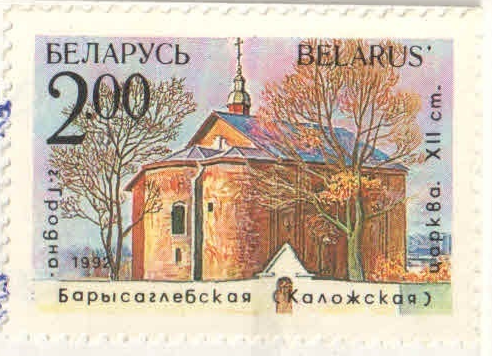
The postcard shows St. Francishak Ksaverya Church and Jesuitical collegium, and the St. Barys and Hleb church in Kalozha.

A lovely pair

Man and doll
17 Jan 2014 | From Katerina of Belarus
OFFICIAL POSTCROSSING

Kate picked this postcard for me adding that this is the most unusual card she have found for me. I like the card :) I love the expression on the man's face. He seems content and proud. The reflection by the pond also makes the postcard more interesting.

Artur Vakarau from the project "Wonderland. Articles"

Zhdanovichi Flea Market
17 Jan 2014 | From Julia of Belarus
OFFICIAL POSTCROSSING

The postcard shows a picture from the most famous flea market in Belarus located in Zhdanovichi, Minsk. People often call it as the “Field of Dreams”. The flea market is like a small village wherein there are about at least 500 sellers selling a variety of goods.

Monday, 31 March 2014

Landscape of Belarus

Berezovsky District, Brest Region
21 Nov 2013 | From Maria of Belarus
OFFICIAL POSTCROSSING

Brest Voblast (Province) or Brest Oblast is a province (voblast) of Belarus with its administrative center being Brest.

It is often dubbed the Western gateway to Belarus. Geographically, the Brest Voblast belongs to the area known as Polesia. The area of the Voblast was part of the Second Polish Republic from 1921 until 1939 largely as the Polesie Voivodeship, when it was joined to the Byelorussian Soviet Socialist Republic. Northeastern part of it was ruled as part of Nowogrodek Voivodeship.

Thursday, 27 March 2014

Nature of Belarus

Nature of Belarus
25 Oct 2013 | From Lora and Antonio of Belarus
POSTCROSSING SWAP

This is the other postcard that arrived in the mail from Lora and his son, Antonio. They wrote a lot of personal things, as well as some information about their country - Belarus.

Belarus is situated in the center of Europe. That is why Belarus is often regarded as the heart of Europe. According to Lora, the standard of living in Belarus is far from most European countries. A lot of young people leave Belarus for other countries to earn money.

She also wrote that people in Belarus are hospitable and kind. They always wear a smile, and are more reserved compared to their neighboring countries.

Belarus’ unique natural environment is host to a fascinating selection of rare plant and animal species. Belarus is a very green landscape. Natural vegetation covers 93.1% of the land, and 1/3 of all green landscape is forest. Belarus is also home to a huge array of wild animals and birds, many of them rare species.

Art of Leonid Afremov


Gold Falls
25 Oct 2013 | From Lora and Antonio of Belarus
POSTCROSSING SWAP

Two postcards from Lora and Antonio arrived today. And this is one of the postcards. I previously received a card from them through the official Postcrossing. They sent me new ones for our swap :)

I actually thought that the painting's correct position is the inverted one - with the subject as if diving (in a weird position). I only found out about it is supposed to be looked (or hanged) this way when I saw it at the internet. 

I love this painting. I love how the colors and strokes create such a movement.

Tuesday, 25 March 2014

Saint Sophia Cathedral in Belarus

Saint Sophia Cathedral | Ivan Medvedev
25 Oct 2013 | From Ira of Belarus
OFFICIAL POSTCROSSING

Saint Sophia Cathedral in Polotsk is probably the oldest church in Belarus. It was built between 1044 and 1066 by Prince Usiaslau - the Wizard. 

The Cathedral stands at the confluence of the Polota and Western Dvina Rivers on the eastern side of the city.

The cathedral was built as a symbol of equality with the second Rome - Constantinople. Like in Kyiv and Novgorod where there were also temples in honour of St Sofia, the Saint Sophia Cathedral in Polotsk was intended to be a testimony to the power and independence of the Principality of Polotsk.

Monday, 24 March 2014

A Leonid Afremov Artwork

Misty Mood
25 Oct 2013 | From Jelip of Germany
OFFICIAL POSTCROSSING

I have been seeing a lot of Leonid Afremov art postcards at Postcrossing, but this is actually the first that I got to receive one.

The artist Leonid Afremov was born in city of Vitebsk, Belarus in 1955-- the same town where Marc Chagall was born. Leonid Afremov graduated from Vitebsk Art School in 1978. The school was founded by Marc Chagall in 1921. Along with Malevich and Kandinsky, Leonid Afremov is one of the elite members of the famous Vitebsk art school.

I think his artistic style is easily recognized. Leonid uses palette-knife instead of regular brushes to put paint on canvas.

Wednesday, 19 March 2014

A sketch from a Belarusian artist

Meltwater. Seagull. 1927
18 Sept 2013 | From Tanyusha of Belarus
OFFICIAL POSTCROSSING

This postcard is a sketch by Vitold Byalynitsky-Birulya (1872~1957). It is kept in the National Art Museum of the Republic of Belarus.

Tanyusha shared that birch trees, which also shown in the sketch, is a symbol of Russia - a neighboring country, but they have them in Belarus too.

Monday, 17 March 2014

Stardust above a Cathedral

A Cathedral at Night
16 Jul 2013 | From Lora and Antonio of Belarus
OFFICIAL POSTCROSSING

I never found out the name of this church or cathedral, but it sure looked beautiful at night with the sky covered in light and stars.

This postcard came from Lora and Antonio (mother and son). They live in the suburb of Minsk, the capital of Belarus. They like walking through the forest, travelling, and getting acquainted with new people and countries. They asked me for a postcard swap after I registered their card :)

Sunday, 16 March 2014

Unexpected surprises

A Belarusian Child
"Greetings from the heart of Europe"

Famous Soccer Players (stickers)
24 Jun 2013 | From Irina Gerasimchik of Belarus
OFFICIAL POSTCROSSING

Irina sent me these surprises along with the official postcard of The River Svisloch. Another postcard and some stickers.

The River Svisloch

The River Svisloch
24 Jun 2013 | From Irina Gerasimchik of Belarus
OFFICIAL POSTCROSSING

Irina sent me a postcard 3rd od April, 2013. I registered it for her 50 days later when she messaged about the still traveling card. This postcard seemed to have gotten lost.

Irina then sent me another postcard - well, postacrds - which finally reached me this time 24th of June.

There are some Belarusian texts at the back of the postcard which Irina kindly translated for me in an attached note. It tells the sad and haunting legend of the River Svisloch.