Showing posts with label Australia. Show all posts

Thursday, 23 July 2015

AU's iconic animal

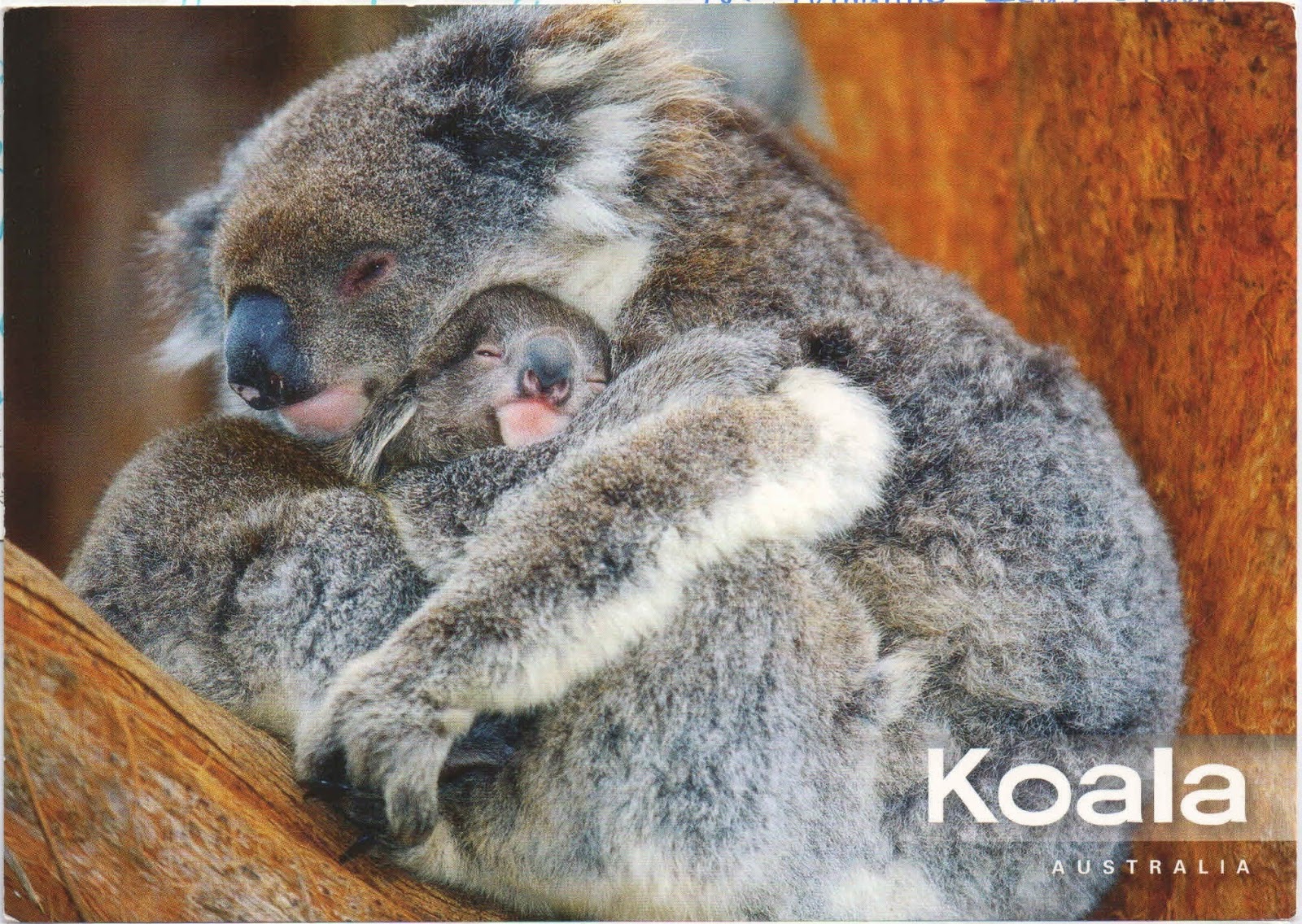
The Koala
10 Apr 2015 | From Shellani of the Philippines
COLLEAGUE FRIEND

Shellani, an office friend, was assigned in Australia for a few months. Before leaving for AU, I told her to send me a postcard from AU and write to me about her experiences while there. She chose this postcard for me adding that it reminded her of me. Interestingly, when I received the postcard, it reminded me of her - hahaha!

This is my second koala postcard. The koala is the official fauna symbol of Queensland, Australia. They are an iconic symbol of Australia, and one of their best known animals. The koala is a small bear-like, tree-dwelling, herbivorous marsupial which averages about 9kg (20lb) in weight. Its fur is thick and usually ash grey with a tinge of brown in places.

The koala gets its name from an ancient Aboriginal word meaning "no drink" because it receives over 90% of its hydration from the Eucalyptus leaves (also known as gum leaves) it eats, and only drinks when ill or times when there is not enough moisture in the leaves. ie during droughts etc.

The koala is the only mammal, other than the Greater Glider and Ringtail Possum, which can survive on a diet of eucalyptus leaves.

Wednesday, 13 May 2015

The Hastings Caves State Reserve

Newdegate cave, Tasmania, Australia
11 Feb 2015 | From Louise of Australia 
OFFICIAL POSTCROSSING

Hastings Caves State Reserve is the setting of a complex of caves and a natural hot springs located 102 km (63 mi) south of Hobart, Australia. It forms part of the Tasmanian Wilderness World Heritage Area. Hastings Caves Reserve is the location of Newdegate Cave, the largest tourism cave in Australia. Newdegate Cave, the largest dolomite cave in Australia open to tourists, is a part of the complex. They are located 5 km from the nearby Lune River fossil/gem center and the Ida Bay Railway. Named after Sir Francis Newdegate, the Governor of Tasmania from 1917-1920, Newdegate Cave is the largest tourist cave in Australia which occurs in dolomite, rather than limestone.

The complex features natural hot springs, which cause many of the local streams to be at a year round temperature of 28 degrees. This feeds a swimming pool at the Hastings Cave visitor center, which is available to visitors to swim in.

The caves were discovered in 1917 by timber workers cutting trees near the entrance of the cave. The caves were initially opened up to tourists in the 1920s, and later the state government stepped in and took control during the Great Depression. Steps and a road to the cave were completed as part of depression era construction work to spur the economy, and the cave was officially opened by Albert Ogilvie, Premier of Tasmania, in 1939.

Thursday, 26 March 2015

An Australian Open Garden

Wayval Views, Queensland
7 Jan 2015 | From Russell of Australia
OFFICIAL POSTCROSSING

This 3-4 acres open terraced garden is located in the heart of the Lockyer Valley, approximately half-way between Toowoomba and Ipswich. It was previously grazing land with only one tree. Now the garden showcases a vast range of trees and shrubs in a beautiful balance of natives and exotics. Murraya, lilly-pilly, box, duranta and privet used as hedges and topiary. Grafted weeping grevilleas. Rock-walled fernery, old slab hut, pond, bird aviary. Glorious panoramic views of the surrounding mountain ranges and valleys. It also includes slab huts, a stone-walled fern house, arbours, gazebos, rustic sculpture, a waterfall and rocky watercourse, bridges, pond and timber boardwalk, cactus garden, orchard and vegetable garden.

Tuesday, 27 January 2015

Great Australian Road Views #1045

The Gulf Hats near Karumba QLD
7 Nov 2014 | From Johanna of Australia
OFFICIAL POSTCROSSING

Karumba is a town in the Gulf Country region of Queensland, Australia. The settlement was previously known as Norman Mouth and Kimberely. Karumba was used by the local aborigines to describe the place. This name was officially used for the township by the 1880s.

Karumba is a fishing town. The town's economy revolves largely around fishing. Karumba is sited at the mouth of the Norman River, and enjoys the distinction of being the only town along the southern Gulf of Carpentaria that is within sight of the Gulf itself. Karumba's existence is connected to the simple fact that it is on the banks of the river and it is set on sand ridges which allow direct access to the river and the sea.

The journey to the town from Normanton passes over an area of very flat Gulf Country. The land is alive with birdlife and it is common to see flocks of cranes and brolgas feeding beside the road.

Monday, 18 August 2014

The Big Pineapple

Big Pineapple Train, Woombly, QLD 
12 Aug 2014 | From Scrapssuka of Australia
OFFICIAL POSTCROSSING

The Big Pineapple is a heritage-listed tourist attraction on the Sunshine Coast in South East Queensland, Australia. It is 16 metre high and was originally opened on the 15 of August 1971.

The Big Pineapple features two rides: One on a Nut Mobile, the other on a small train that takes passengers on a tour of the plantation and lets them optionally disembark at a small zoo situated on the property. The rides take visitors around the plantation while the driver broadcasts information about the plants at the plantation, along with a history.

Source: Wikipedia

Wednesday, 25 June 2014

A gathering place

Fremantle, Western Australia
19 Jun 2014 | From Jeff of Australia
OFFICIAL POSTCROSSING

Named after Captain Charles Fremantle, the English naval officer who had pronounced possession of Western Australia, Fremantle Fremantle is the lively port city 30 minutes southwest of Perth in Western Australia. The historical city of Fremantle has many well-preserved 19th-century buildings including the Round House, which is the oldest remaining building in Western Australia.

Aboriginal Australians call the Fremantle area 'Manjaree' which means 'gathering place'.

Sunday, 27 April 2014

Most beautiful natural harbour

Sydney Harbour and the Sydney Opera House
19 Feb 2014 | From Susan of New Zealand
FACEBOOK SWAP | POSTCARD SENT FROM AUSTRALIA

This is a postcard swap from Susan of New Zealand - from whom I won The Hobbit lottery postcard :) She went on a trip to Australia and sent some postcards while there.

Sydney Harbour is commonly referred to as the most beautiful natural harbour in the world. It is a r is a beautiful meandering waterway, famous around the world. It’s also a natural playground for Sydneysiders and visitors who use it for sailing, swimming, diving and walking around its foreshore.

The Sydney Opera House constitutes a masterpiece of 20th century architecture. Its significance is based on its unparalleled design and construction; its exceptional engineering achievements and technological innovation and its position as a world-famous icon of architecture. It is situated on Bennelong Point in Sydney Harbour, close to the Sydney Harbour Bridge, the facility is adjacent to the Sydney central business district and the Royal Botanic Gardens, between Sydney and Farm Coves.

Monday, 7 April 2014

Mother and child koala

Koala mother with her joey
29 Nov 2013 | From Sulea of Australia
FACEBOOK SWAP

Koalas are indigenous to Australia and live in tropical to temperate eucalypt forest and woodlands and can be found along the eastern and south-eastern regions. Their closest living relatives are the wombats.

It is easily recognisable by its stout, tailless body; round, fluffy ears; and large, spoon-shaped nose. The koala has a body length of 60–85 cm (24–33 in) and weighs 4–15 kg (9–33 lb).

Like other marsupials, a koala mother carries her baby in a pouch until it is large enough to ride on her back or belly. When not asleep a koala feeds on eucalyptus leaves, especially at night. Koalas do not drink much water and they get most of their moisture from these leaves. They rarely leave these trees, and their sharp claws and opposable digits easily keep them aloft.

Monday, 31 March 2014

The Blue Mountains

The Blue Mountains World Heritage Area
21 Nov 2013 | From Don of Australia
OFFICIAL POSTCROSSING

This postcard from the official Postcrossing track arrived without a postcard ID code. Luckily, I was able to find the unknown ID with the help of Postcrossing. Good thing the sender wrote a lot of information that helped in finding the ID :)

The blue-hazed beauty of the Blue Mountains World Heritage Area – one million hectares of tall forests, sandstone cliffs, canyons, waterfalls and bushland, is one of the most breathtaking sites in Australia. Spectacular sandstone cliff formation dominate The Blue Mountains World Heritage Area, particularly here within the Grosse Valley.

Don sent this postcard of the Hanging Rock as it shows the natural beauty of the region in which he lives, Springwood. Springwood is the largest village in the Blue Mointains, and is famous for the Grave of Sir Henry Parkes, the Father of Australian Federation; the Corridor Oaks; and the home, studio, and gallery of famous Australian artist, Norman Lindsay (1879~1969).

The Blue Mountain is a National Park and a World Heritage Site. The City of Blue Mountains is a city within a National Park.

Monday, 10 March 2014

My First Postcard from Australia

German Policemen
22 Jan 2013 | From Margaret of Australia
OFFICIAL POSTCROSSING

My first postcard from Australia, thanks to Ms. Margaret | About the card: German policemen use a wireless to receive news from a patrol, c. 1925