Showing posts with label Japan. Show all posts

Wednesday, 18 November 2015

The Forest Spirit

My Neighbor Totoro
6 May 2015 | From Lucia of Spain
POSTCROSSING SWAP (INSTAGRAM) | POSTCARD SENT FROM SPAIN

My Neighbor Totoro is a heartwarming, sentimental masterpiece that captures the simple grace of childhood. It is a 1988 Japanese animated fantasy film written and directed by Hayao Miyazaki and produced by Studio Ghibli. It tells the story of the two young daughters (Satsuki and Mei) of a professor and their interactions with friendly wood spirits in postwar rural Japan.

'My Neighbor Totoro' has become one of the most beloved of all family films, and the film's central character, Totoro, is as famous among Japanese children as Winnie-the-Pooh is among British ones. They have become such Japanese cultural icons.

Miyazaki has said that Totoro is "not a spirit: he's only an animal. I believe he lives on acorns. He's supposedly the forest keeper, but that's only a half-baked idea, a rough approximation.

Sights in Tokyo

Sightseeing in Tokyo, Japan
6 May 2015 | From Akubi of Hong Kong
POSTCROSSING FRIEND | POSTCARD SENT FROM HK

It's difficult to grasp how big the city of Tokyo really is. While Tokyo proper itself has over 13 million people, the metropolitan urban area is much bigger. Tokyo is one of the most powerful cities in the world in terms of economy and global influence, and it also maintains an incredible tourist atmosphere.

Tokyo is bustling with an eclectic mix of stunning, all-encompassing modernity and a fascinating tinge of the traditional. From mid-hike beer gardens to an amazing gourmet cuisine living off some of the best fresh markets in the world, Tokyo is an excellent city to pay a visit. Grab yourself a Harajuku fashionista and spend a romantic late evening watching the Tokyo Tower lights turn off. Hop on a train line and head down to the Golden Gai district for a drink at a 2,000 square meter den.

Source: Visit Tokyo

Tuesday, 4 August 2015

Super Sentai 35th Anniversary

Gokaiger Gokai Red
10 Apr 2015 | From Dennis of the Philippines
POSTCARD SURPRISE

The Super Sentai Series is the name given to the long-running Japanese superhero team genre of shows produced by Toei Co., Ltd., Toei Agency and Bandai, and aired by TV Asahi. The shows are of the tokusatsu genre, featuring live action characters and colorful special effects, and are mainly aimed at children. The Super Sentai Series is one of the most prominent tokusatsu productions in Japan, alongside the Ultra Series and the Kamen Rider Series. Outside Japan, the Super Sentai Series is best known as the source material for the Power Rangers franchise.

The first Super Sentai Series, Himitsu Sentai Gorenger, was created by Shotaro Ishinomori (creator of Kamen Rider and Cyborg 009) in 1975.

The Gokaigers are the fictional protagonists featured in the 35th Super Sentai Series Kaizoku Sentai Gokaiger. The Gokaigers battle against the antagonist group, the Space Empire Zangyack. The Gokaigers are a group of young pirates from space that hear of the legend of the Greatest Treasure in the Universe, which leads them to Earth. The transform into Gokai Pink, Gokai Green, Gokai Silver, Gokai Red, Gokai Blue and Gokai Yellow. Each member of the Gokaigers has a bounty on their heads by the Zangyack Empire for opposing their invasion.

Captain Marvelous is Gokai Red, the young captain of the Gokai Galleon. He was originally a resident of a planet invaded by the Zangyack Empire before turning to piracy, though he had no desire or motivation except to pursue the Greatest Treasure in the Universe. Though he is the team leader, Captain Marvelous is an unpredictable sort of character who does reckless things to satisfy his curiosity, stating his actions as what any pirate would do in that particular moment, earning the ire of his crew. But his sense of responsibility as a leader is still very well intact, as shown when if his crew is ever in mortal danger, he would use his authority as captain and sacrifice himself, much like Aka Red did for him, to ensure their safety. He is much stronger than he looks as he is usually seen exercising himself by wearing a heavy bracelet while playing darts.

Tuesday, 26 May 2015

Forest in Kagoshima Prefecture

Shiratani Unsuikyo. Yakushima
10 Mar 2015 | From Yulia of Japan
OFFICIAL POSTCROSSING

Kagoshima Prefecture consists of the southernmost part of Kyushu and the northern half of the Nansei Shoto, the island group that stretches from Kyushu to Taiwan. The prefecture's former name is Satsuma. Satsuma played a crucial role in realizing the Meiji Restoration and during the Meiji Period.

Yakushima is a subtropical island off the southern coast of Kyushu and part of Kagoshima Prefecture. It is covered by an extensive cedar forest that contains some of Japan's oldest living trees. The Shiratani Unsuikyo Ravine on Yakushima is a lush, green nature park containing a number of the island's ancient cedars such as the Nidaiosugi, Kugurisugi and Yayoisugi, the park's most accessible yakusugi which can be reached in a 15 minute walk. Shiratani Unsuikyo is a popular destination to see the forests without much strenuous hiking.

Source: Japan Guide

Wednesday, 13 May 2015

Monster Princess

 
The Princess Mononoke
11 Feb 2015 | From Mina of Japan
OFFICIAL POSTCROSSING

Princess Mononoke is a landmark in the world of animation. With its epic story and breathtaking visuals, it is a beautifully realized tale of civilization versus nature. Princess Mononoke is a 1997 anime epic action historical fantasy film written and directed by Hayao Miyazaki. It was animated by Studio Ghibli and produced by Toshio Suzuki.

Set in the late Muromachi period, Princess Mononoke follows the journey of the last Emishi prince, Ashitaka, and his attempts to make peace between the human settlement, Irontown, and the creatures living in the forest that surrounds it. Ashitaka finds himself in the middle of a war between the forest gods and Tatara, a mining colony. In this quest he also meets San, the Mononoke Hime. The term "Mononoke" is not a name, but a Japanese word for a spirit or monster.

A central theme of Princess Mononoke is the environment. The film centers on the adventure of Ashitaka as he journeys to the west to undo a fatal curse inflicted upon him by Nago, a boar turned into a demon by Eboshi. Two other themes found in the plot of Princess Mononoke are sexuality and disability. The disabled and gendered sexual bodies were partially used as a transition from the feudal era to a hegemony that "embraces modern social systems, such as industrialization, gendered division of labor, institutionalization of people with diseases, and militarization of men and women. A potential theme could be that of lost innocence. Miyazaki attributes this to his experience of making his previous film, Porco Rosso, and the wars in the former Yugoslavia, which he cites as an example of mankind never learning, making it difficult for him to go back to making a film such as Kiki's Delivery Service, where he has been quoted as saying "It felt like children were being born to this world without being blessed. How could we pretend to them that we're happy?

Monday, 11 May 2015

Rock Garden of Ryoan-ji Temple, Kyoto

Toranoko Watashi
3 Feb 2015 | From Junko of Japan 
OFFICIAL POSTCROSSING

The rock-garden 'Toranoko Watashi' is the most beautiful stone garden in Kyoto. Soami (?~1525), who created it, expresses his understanding of Zen enlightenment with simplicity.

Nanzenji is one of the most important Zen temples in Japan as it is ranked as above the five greatest Zen temples in Kyoto. It was first built as an imperial villa in 1264.  The gardens in the compound are also must-sees, especially the well-known dry-landscape garden in O-hojo which is called “Toranoko watashi” (young tigers crossing the water).

Thursday, 16 April 2015

Criminal Shinobis

The Akatsuki
7 Jan 2015 | From Wei Yi of Malaysia
POSTCROSSING FRIEND

Akatsuki is an organization of criminal ninja that serves as the primary antagonistic force of the second part of the Naruto series. It was founded by Yahiko, Nagato and Konan under instruction from Obito Uchiha.

Akatsuki seeks to capture the Bijuu and their hosts the "Jinchuuriki," meaning the power of human sacrifice. These are the individuals possessing bijuu (tailed beasts) within their bodies. Akatsuki's current base of operation is unknown, however they have multiple bases to which they can travel. These bases are used to summon the gigantic King of Hell statue known as Gedou Mazou. The statue's mouth is bound and his hands are cuffed. Each respective finger of the statue's hand represents the Akatsuki member. 

The members have the ability to project their presence to their base, this allows them to remain out and about and still conduct the business of Jinchuuriki demon extraction. Akatsuki's ultimate goal is to control the world. This would be accomplished through capturing and sealing away the Bijuu into the Gedou Mazou statue.

The Akatsuki members shown in the postcard are Kakuzu, Tobi, Deidara, and Hidan. 
Hidan (former member - neutralized) hails from Hot Springs village. He and his partner Kakuzu were responsible for acquiring the Two-Tailed Jinchuuriki. Hidan practices an evil god cult religion named Jashin. This religion loves chaos and death, and Hidan himself is near immortal due to the Kinjutsu used on him by Jashin.

Kakuzu is a missing-nin from Hidden Waterfall. He was a bounty hunter who often got sidetracked on bounty hunts. His body was stitched together by strange tendrils which he used to rip out the hearts of his opponents and then insert into his own body. This granted him their elemental affinities in the form of masked tendril entities.

Deidara and Tobi share a very strained relationship. Always eager to impress his new teammates, Tobi was prone to excitement. This often annoyed Deidara who tried to do his best to show Tobi what it meant to be an Akatsuki member. Tobi was assigned to capture the Sanbi. Though he boasted that he took out the beast himself, he was helped in his assignment by Deidara. Deidara was unaware of Tobi's true nature during their time together.

Monday, 17 November 2014

The largest Shinto Festival

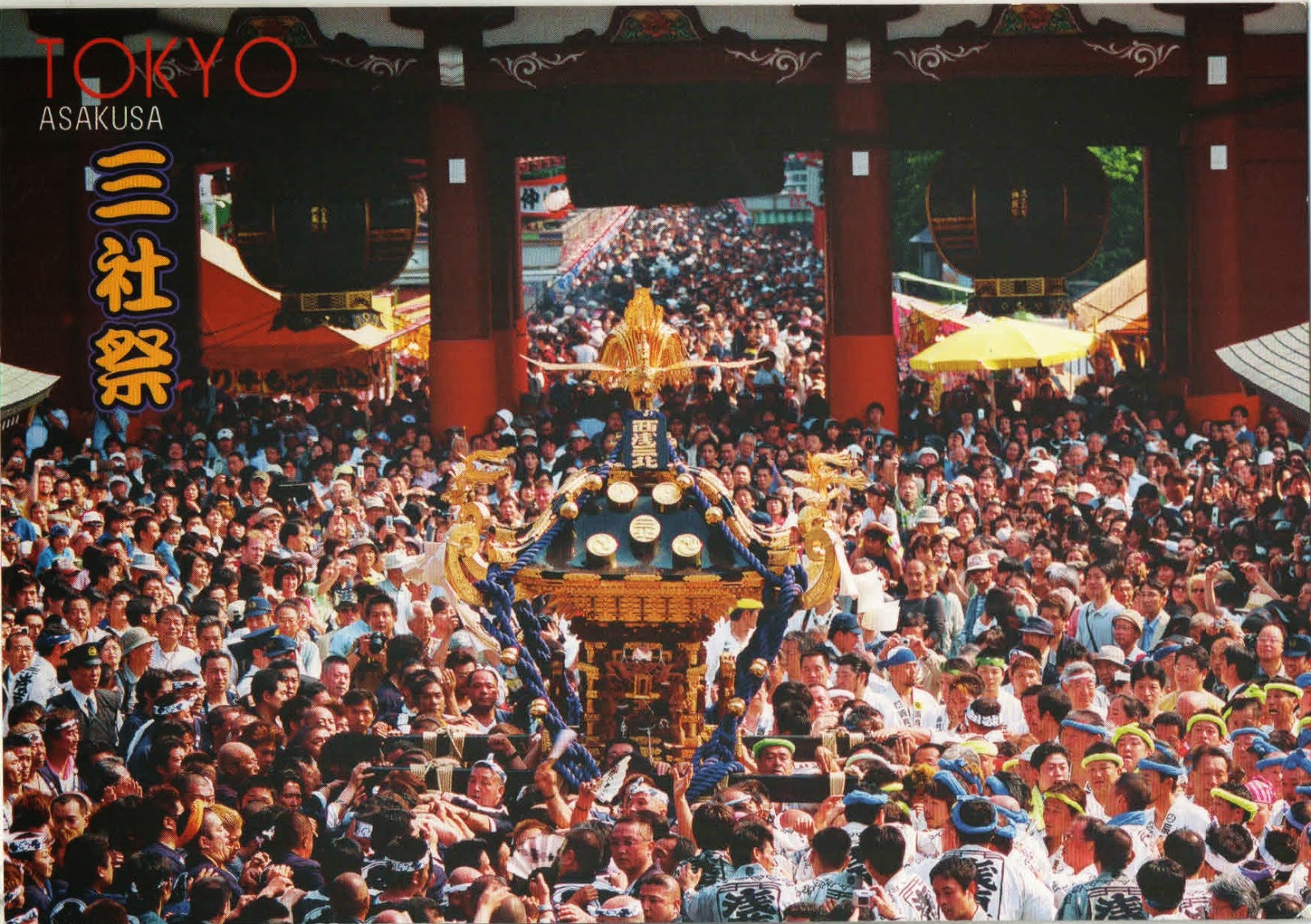
The Sanja Festival
10 Oct 2014 | From Ruco of Japan
OFFICIAL POSTCROSSING

Sanja Festival is one of the three great Shinto festivals in Tokyo. It is held in May every year. Sanja Matsuri, literally "Three Shrine Festival",  is considered one of the wildest and largest.

The festival is held in honor of Hinokuma Hamanari, Hinokuma Takenari and Hajino Nakatomo, the three men who established and founded Sensō-ji. Its prominent parades revolve around three mikoshi (three portable shrines referenced in the festival's name), as well as traditional music and dancing. Over the course of three days, the festival attracts 1.5 to 2 million locals and tourists every year.

More information at Japan Guide.

Source: Wikipedia

Tuesday, 4 November 2014

A postcard from Ghibli Museum in Mitaka

The Spirit Realm
4 Oct 2014 | From Eriko of Japan
OFFICIAL POSTCROSSING

The postcard seemed vaguely familiar until I realized it is a setting from the movie Spirited Away. The Spirit Realm or the Spirit World is the main setting for this Japanese animated film. It is home to The Bathhouse owned by Yubaba and Zeniba's Cottage, two of the film's core locations. The Spirit Realm is largely similar and directly linked to the Human World. Like the Human World the Spirit Realm is quite large in size, with most of its revealed locations covered in a vast amount of water.

Spirited Away is of my Ghible favourites. It  tells the story of Chihiro Ogino (Hiiragi), a sullen ten-year-old girl who, while moving to a new neighborhood, enters the spirit world. After her parents are transformed into pigs by the witch Yubaba (Natsuki), Chihiro takes a job working in Yubaba's bathhouse to find a way to free herself and her parents and return to the human world.

This postcard was from the Ghibli Museum, a museum showcasing the work of the Japanese animation studio Studio Ghibli. It is located in Inokashira Park in Mitaka, a western city of Tokyo, Japan. The museum combines features of a children's museum, technology museum, and a fine arts museum, and is dedicated to the art and technique of animation.

Scene from the movie 'Spirited Away'

Wednesday, 24 September 2014

Hiromi Nishizaka 2011 Exhibition

Weeping Clouds
10 Sept 2014 | From Hanako of Japan
OFFICIAL POSTCROSSING

Born in Kanagawa, Japan, Hiromi Nishizaka is an artist and illustrator who uses pen, pigment ink and watercolor to create illustrations which powerfully evokes the nature and animals. Oneiric and surreal, her work is rooted in magic, folklore and fantasy. Honoured with many awards internationally, Nishizaka has had solo exhibitions since 2006 and has participated in several group exhibitions.

Source: Artchipel

Monday, 2 June 2014

Art of Tsuchida Bakusen

Maiko in a garden 
28 May 2014 | From Yukari of Japan 
OFFICIAL POSTCROSSING

Tsuchida Bakusen (February 9, 1887~June 10, 1936) is the pseudonym of a Japanese painter in the Nihonga style, active during the Taishō and early Shōwa eras. His birth name was Tsuchida Kinji.

His painting Maiko in Garden from 1924, owned by The National Museum of Modern Art in Tokyo, is considered his masterpiece.

Sunday, 25 May 2014

Post Pop Graphics

Art by Yusuke Nakamura
12 May, 2014 | From Komichi of Japan
OFFICIAL POSTCROSSING

Yusuke Nakamura is a rising star in the Japanese art world. Nakamura’s colorful pictures incorporate the look of comic book art along with more surreal and traditional artistic elements, resulting in a unique visual style. Animals form a major part of the works, often in unusual form.

Source: Czech Centres

Tuesday, 20 May 2014

An explosive threat

 
Deidara
23 Apr 2014 | From Wei-yi of Malaysia
POSTCROSSING FRIEND (FACEBOOK) | POSTCARD SENT FROM MALAYSIA

Akatsuki (literally meaning "Dawn" or "Daybreak") was initially an organisation created by Yahiko and his two comrades Konan and Nagato in an effort to fight against the tyranny and oppression that their home village Amegakure was facing during the Third Great Shinobi War, and the long-term goal of world peace.

After Yahiko's death and under the influence of Obito Uchiha, Akatsuki became a criminal organisation comprising S-rank missing-nin and is the most wanted group in all of the shinobi world.

Deidara was recruited to replace Orochimaru as Sasori's partner, but because Orochimaru took his Akatsuki ring with him he could not replace Orochimaru's position. Deidara possessed the Explosion Release kekkei genkai. This allowed him — by simultaneously using two (currently unknown) chakra natures — to give his chakra explosive qualities. Deidara also possessed special mouths in the palms of his hands and on the left side of his chest as a result of stealing and using a powerful kinjutsu from his village on himself.

Source: Naruto Wikia

Thursday, 24 April 2014

Maiko-girl in Kyoto

Maiko-girl in Kyoto
8 Feb 2014 | From Phoebe of Taiwan
FACEBOOK SWAP | POSTCARD SENT FROM TAIWAN

Maiko are young geisha ranging in age from 15 to 20 or 21 years old. The literal meaning of maiko is "dancing child/girl"

Phoebe shared that you can actually see a lot of geishas and maikos walking in the streets of Kyoto wearing their kimono. But not all are geishas. Some are just tourists taking part of the "kimono experience" tour.

Japanese Beauty

The Japanese Geisha
8 Feb 2014 | From Phoebe of Taiwan
FACEBOOK SWAP | POSTCARD SENT FROM TAIWAN

Phoebe bought this postcard from her trip to Japan December 2013. She wrote a few things about the card. She shared that Geishas are merely performers, and are not prostitutes. They are traditional Japanese female entertainers who act as hostesses and whose skills include performing various Japanese arts such as classical music, dance and games. The meaning of gei is "art" and sha means "person of".

Lottery Postcard from Phoebe (Taiwan)

Okayama Gotochi Card
8 Feb 2014 | From Phoebe of Taiwan
LOTTERY POSTCARD FROM FACEBOOK | POSTCARD SENT FROM TAIWAN

I won this postcard from Phoebe's lottery. She will be traveling to Japan so she initiated this lottery. She asked a series of questions about Japan in Facebook, and I was able to answer three correctly. Initially, the postcard I won was that of a picture of a samurai. However she was not able to find a copy in Japan so she sent me this instead :)

Phoebe shared to me this interesting tale about Momotarou (Peach Boy), the boy in the postcard. Okayama is the native town of Momotarou. It was said that Momotarou was found living in a peach. When he grew up, we went to fight against the evils on the ghost island. During his trip, he met a dog, a monkey, and a bird. All of them became friends.

Okayama has many sunny days throughout the year. In combination with its mild climate, this makes it the ideal place for growing fruit. Many different kinds of fruits, including white peaches and grapes, are grown here. The fruit of Okayama is a popular brand among the people of Japan. - Discover Okayama

Tuesday, 15 April 2014

Kitsune no Yomeiri

The Fox's Wedding
17 Jan 2014 | From Nanami of Japan
OFFICIAL POSTCROSSING

The Kitsune no Yomeiri ("the fox's wedding") is a strange event told about in Honshu, Shikoku, and Kyushu. The "kitsune no yomeiri" can refer to several things: atmospheric ghost lights, a phenomena during which it appears as if paper lanterns from a wedding procession are floating through the dark; what is commonly referred to as a sunshower; and various strange wedding processions that can be seen in classical Japanese kaidan, essays, and legends. The "kitsune no yomeiri" is always closely related to foxes (who often play tricks on humans in Japanese legend) and various Shinto rituals and festive rights relating to the "kitsune no yomeiri" have been developed in various parts of Japan.

Fox's weddings were not merely phenomena of nature, but also things that were actually seen in the old literature of the Edo Period as well as various legends depending on the area. A retelling of the legend appeared in Tales of Old Japan by Algernon Bertram Freeman-Mitford. You can read the story of the fox's wedding here.

Sources: Wikipedia, Academia

Monday, 7 April 2014

Japanese Kimono

Illustrated Japanese Kimono
29 Nov 2013 | From Akubi of Hong Kong
POSTCARD SENT FROM HONG KONG

Kimonos (着物) are traditional Japanese style clothes. Originally, "kimono" was the Japanese word for clothing. But in more recent years, the word has been used to refer specifically to traditional Japanese clothing. Kimonos as we know them today came into being during the Heian period (794-1192).

Nowadays, Japanese people rarely wear kimonos in everyday life, reserving them for such occasions as weddings, funerals, tea ceremonies, or other special events, such as summer festivals.

The Hong Kong stamp is glued in front of the card. The other stamp is the third series of the Sign Language stamps from Singapore.

Wednesday, 2 April 2014

Maiko Girls

Maiko at the Golden Pavilion in Kyoto
29 Nov 2013 | From Masayo of Japan
OFFICIAL POSTCROSSING

Maiko dancers on wooden clogs share a paper umbrella. Hanging down on their back are silk obi sashes with elaborate embroidery.

Maiko is an apprentice geisha in western Japan, especially Kyoto. Their jobs consist of performing songs, dances, and playing the shamisen (three-stringed Japanese instrument) for visitors during feasts. Maiko are usually aged 15 to 20 years old and become geisha after learning how to dance (a kind of Japanese traditional dance), play the shamisen, and learning Kyō-kotoba (dialect of Kyoto), regardless of their origins.

Friday, 28 March 2014

World's best pirates

One Piece
25 Oct 2013 | From Kotomi of Japan
FACEBOOK SWAP

One Piece (ワンピース) is a Japanese manga series written and illustrated by Eiichiro Oda. It has been serialized in Weekly Shōnen Jump since August 4, 1997; the individual chapters are being published in tankōbon volumes by Shueisha, with the first released on December 24, 1997, and the 73rd volume released as of March 2014. One Piece follows the adventures of Monkey D. Luffy, a young boy whose body gains the properties of rubber after unintentionally eating a Devil Fruit, and his diverse crew of pirates, named the Straw Hat Pirates. Luffy explores the ocean in search of the world's ultimate treasure known as One Piece in order to become the next Pirate King.

The chapters have been adapted into an original video animation (OVA) produced by Production I.G in 1998, and an anime series produced by Toei Animation, which began broadcasting in Japan in 1999. Since then, the still ongoing series has aired over 600 episodes. Additionally, Toei has developed eleven animated feature films, two OVA's, and five television specials. Several companies have developed various types of merchandising such as a trading card game, and a large number of video games.